
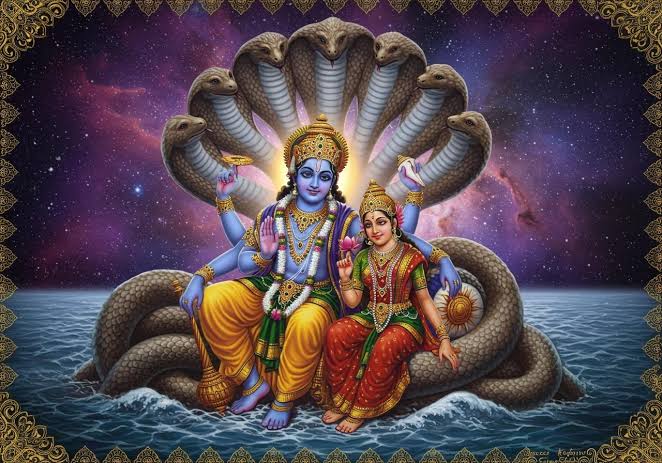
Lord Vishnu is one of the principal deities in Hinduism and is revered as the "Preserver" or "Protector" of the universe.
Lord Vishnu: The Preserver of the Universe
Lord Vishnu is one of the principal deities in Hinduism and is revered as the "Preserver" or "Protector" of the universe. Together with Brahma (the Creator) and Shiva (the Destroyer), Vishnu forms the Hindu trinity known as the Trimurti. Vishnu's role is to maintain the order and balance of the cosmos, safeguarding the world from evil, chaos, and destruction.
Vishnu is typically depicted with a calm, serene expression, symbolizing his peaceful and compassionate nature. He is often shown with four arms, each holding a symbolic object:
Vishnu is often portrayed resting on the cosmic serpent, Sheshnag, floating on the ocean of milk. His blue complexion symbolizes his infinite nature and his connection to the vastness of the universe.
To fulfill his role as the preserver of cosmic order (dharma), Vishnu is believed to have incarnated on Earth in various forms, known as avatars. These avatars are taken whenever evil threatens to upset the balance of the universe. There are ten principal avatars, collectively known as the Dashavatara, which are:
Vishnu is eternally associated with Goddess Lakshmi, the goddess of wealth, fortune, and prosperity. She is believed to incarnate alongside Vishnu in his different avatars. For instance, she appears as Sita in the Ramayana and as Rukmini or Radha in the Mahabharata.
In Hindu philosophy, Vishnu represents the principle of sustenance and balance. His essence can be found in the teachings of compassion, patience, truth, and dharma. The Bhagavad Gita, a conversation between Lord Krishna (an avatar of Vishnu) and the warrior Arjuna, is one of the most significant spiritual texts in Hinduism. It outlines the principles of duty, devotion, and selfless action.
Vishnu is worshipped by millions of Hindus worldwide. Some of the most famous temples dedicated to Vishnu include:
Vishnu's worship involves rituals, offerings, and the recitation of prayers and hymns, such as the Vishnu Sahasranama (the thousand names of Vishnu).